New York City's property engineers are renowned for their capability to transform cramped quarters into habitable, useful rooms. With the city's dense population and overpriced real estate prices, these design professionals have actually developed a toolkit of methods to optimize every square inch. One cutting-edge approach is multi-functional furnishings: believe beds with built-in storage or dining tables that convert into work areas. Yet it's not practically furniture; it's additionally regarding creating illusions of space with critical lighting and mirrored surface areas, which can make a small room show up almost double its dimension!
Understanding that each client has one-of-a-kind demands, NYC designers dive deep right into personalized solutions. For instance (and there are several), they might create custom shelving that fits comfortably into otherwise unusable spaces or include concealed areas in walls for added storage space. These tailored treatments are vital due to the fact that they reflect an individual's lifestyle while making certain the space continues to be clutter-free and cosmetically pleasing.
When you can not increase in an outward direction, the only means is up! Engineers in New York City City have come to be masters at using vertical area-- mounting loft space beds or elevated platforms for offices and lounges are common methods of the profession. High ceilings are made use of with high shelving systems or even by adding additional mezzanine levels where zoning codes allow. This not only develops even more floor location but also adds personality and measurement to a studio or one-bedroom apartment!
To put it short, today's New York City designers aren't simply concentrated on making best use of area; they're likewise committed to sustainability and smart home modern technology that improves living experiences within tiny impacts. Including energy-efficient home appliances, lasting materials, and home automation systems can significantly minimize ecological influence while providing residents with contemporary conveniences-- really an exciting time for city dwellers aiming to live huge in little areas!
An designer is a specialist that is educated and licensed to strategy, style, and supervise the building of buildings. They are associated with every phase of the development procedure from the preliminary concept to the completed structure. Architects need to possess a combination of imaginative style abilities and practical technical knowledge to guarantee that buildings are risk-free, useful, aesthetically pleasing, and satisfy the requirements of their occupants. Their function includes working together with different specialists such as engineers, specialists, and city coordinators to bring their designs to life within the restraints of budget, guidelines, and structural honesty.
An designer is a expert in charge of the preparation, style, and oversight of structure construction. The term " engineer" comes from the Latin "architectus," which subsequently is originated from the Greek words "arkhi-" (chief) and "tekton" (builder), indicating primary building contractor.
Throughout background, there was no clear difference between designers and engineers till relatively contemporary times. Typically, master builders or craftsmens like stone masons and carpenters embarked on both the style and construction of buildings. It had not been till the Renaissance duration in Europe that we started to see a separation in between the roles of an engineer and an designer.
One historical number who played a significant role fit what we currently think about the occupation of design is Filippo Brunelleschi, an Italian designer significant for his work throughout the Renaissance. He is especially prized for his growth of direct perspective, which reinvented how area could be depicted in art and layout-- a strategy that ended up being crucial for architectural representation.
Prior to the advent of paper ending up being widely readily available in Europe around 1500 complied with by pencils being utilized for attracting by 1600, architects often relied on more simple tools to interact their designs. With these new products at their disposal, pre-construction illustrations became an integral part of building method enabling designers to share their principles more plainly.
In regards to education and learning and professional practice, it has actually become common across the majority of established countries that exercising architecture calls for licensure or registration with pertinent authorities. This typically includes obtaining a level from a college program recognized in architecture, finishing practical experience with internships or practicums, and passing detailed assessments.
Engineers have additionally historically been entailed with seeking advice from numerous specialists such as structural engineers or mechanical designers throughout the style process to ensure all facets are well-coordinated. Making use of technology has actually substantially affected contemporary building practice with tools like Structure Details Modeling (BIM) and computer-aided design (CAD) coming to be market standards.
In addition to making buildings that are cosmetically pleasing and functional, engineers have to likewise adhere to local building regulations and laws consisting of zoning laws, safety and security requirements, ecological sustainability criteria-- usually including energy-efficient layouts or renewable resource resources right into their projects.
The fee framework for architects' solutions can vary but has actually typically been based upon percents connected to construction value or repaired lump sums depending on task complexity. Designers might likewise specialize within certain areas such as sustainable layout or historic preservation or move right into relevant fields like realty advancement or urban planning.
There are numerous expert organizations around the world committed to supporting architects in their occupation development consisting of The International Union of Architects (UIA), The American Institute of Architects (AIA), Royal Institute of British Architects (RIBA), to name a few.
Acknowledgment within the field can come through honors and honors such as Fellowships within specialist companies based on payments to design by means of quality in design or education and learning. One significant honor is the Pritzker Prize-- usually described as "the Nobel Reward for style"-- which acknowledges extraordinary ability worldwide.
 | This article needs additional citations for verification . ( October 2014 ) |
 An architect, 1893. | |
| Occupation | |
|---|---|
| Names | Architect |
| Occupation type | Profession |
| Activity sectors | Architecture Civil engineering Structural engineering Construction Project management Urban planning Interior design Visual arts |
| Description | |
| Competencies | Engineering, technical knowledge, building design, planning and management skills |
| Education required | See professional requirements |
An architect is a person who plans, designs, and oversees the construction of buildings. [ 1 ] To practice architecture means to provide services in connection with the design of buildings and the space within the site surrounding the buildings that have human occupancy or use as their principal purpose. [ 2 ] Etymologically, the term architect derives from the Latin architectus , [ 3 ] which derives from the Greek [ 4 ] ( arkhi - , chief + tekton , builder), i.e., chief builder. [ 5 ]
The professional requirements for architects vary from location to location. An architect's decisions affect public safety, and thus the architect must undergo specialised training consisting of advanced education [ 6 ] and a practicum (or internship) for practical experience to earn a license to practice architecture. Practical, technical, and academic requirements for becoming an architect vary by jurisdiction though the formal study of architecture in academic institutions has played a pivotal role in the development of the profession .
Throughout ancient and medieval history, most architectural design and construction was carried out by artisans —such as stone masons and carpenters—who rose to the role of master builders. Until modern times, there was no clear distinction between architect and engineer. In Europe, the titles architect and engineer were primarily geographical variations that referred to the same person, often used interchangeably. [ 7 ] [ 8 ] "Architect" derives from Greek ἀρχιτέκτων ( arkhitéktōn , "master builder," "chief tektōn ). [ 5 ]

To make the most of limited square footage in New York City apartments, residential architects often employ several key design strategies. These include multi-functional furniture, built-in storage solutions, vertical space utilization with high shelves and lofted areas, and an open floor plan to create a sense of spaciousness. Mirrors can also be used strategically to amplify natural light and give the illusion of a larger room.
In small living spaces, lighting plays a crucial role not only in functionality but also in creating an illusion of more space. Employing layered lighting with a mix of ambient, task, and accent lights can enhance the overall ambiance while making rooms feel larger. Natural light should be maximized with reflective surfaces and translucent window treatments; artificial lighting should be carefully planned to eliminate dark corners and visually expand the space.
Custom-built solutions are tailored specifically to the unique dimensions and needs of a small living space. They can optimize every inch by fitting into irregular spaces or serving multiple purposes—for example, a bed with built-in drawers or a dining table that converts into a workspace. Custom cabinetry can align seamlessly with walls to reduce visual clutter, thereby making spaces feel tidy and more spacious.
Innovative materials such as transparent or reflective surfaces help bounce light around a room, giving an airy feel. Lightweight and movable partitions enable flexible layout configurations. Advances in construction techniques have led to thinner insulation materials that preserve interior space without compromising thermal efficiency. Modern wall beds that fold up during the day or compact appliances designed for tiny kitchens also contribute significantly to saving valuable space.
| New York | |
|---|---|
 Midtown Manhattan with the Empire State Building (center) and Lower Manhattan with One WTC (background) | |
| Nicknames: | |
| |
Coordinates: 40°42′46″N 74°00′21″W / 40.7127°N 74.0059°W / 40.7127; -74.0059[2]Country United StatesState New YorkConstituent counties (boroughs)Bronx (The Bronx)
Kings (Brooklyn)
New York (Manhattan)
Queens (Queens)
Richmond (Staten Island)Settled1624 (1624)Consolidated1898 (1898)Named forJames, Duke of YorkGovernment
• TypeStrong mayor–council • BodyNew York City Council • MayorEric Adams (D)Area
• Total472.43 sq mi (1,223.59 km2) • Land300.46 sq mi (778.18 km2) • Water171.97 sq mi (445.41 km2)Highest elevation
401 ft (122 m)Lowest elevation
0 ft (0 m)Population
• Total8,804,190 • Estimate
8,258,035 • Rank1st in the United States
1st in New York State • Density29,302.7/sq mi (11,313.8/km2) • Urban
19,426,449 • Urban density5,980.8/sq mi (2,309.2/km2) • Metro
20,140,470DemonymNew YorkerGDP
• Total$1.206 trillion (2022) • Metro$2.163 trillion (2022) (1st)Time zoneUTC–05:00 (EST) • Summer (DST)UTC–04:00 (EDT)ZIP Codes
Area codes212/646/332, 718/347/929, 917FIPS code36-51000GNIS feature ID975772Websitenyc
Main article: Culture of New York City
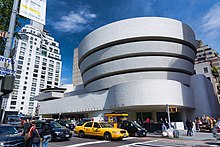
Solomon R. Guggenheim Museum seen from Fifth Avenue
New York City is frequently the setting for novels, movies, and television programs and has been described as the cultural capital of the world.[428][429][430][431] In describing New York, author Tom Wolfe said, "Culture just seems to be in the air, like part of the weather."[432]
The city is the birthplace of many cultural movements, including the Harlem Renaissance in literature and visual art;[433][434] abstract expressionism (known as the New York School) in painting; and hip-hop,[184][435] punk,[436] hardcore,[437] salsa, freestyle, Tin Pan Alley, certain forms of jazz,[438] and (along with Philadelphia) disco in music. New York City has been considered the dance capital of the world.[439][440]
One of the most common traits attributed to New York City is its fast pace,[441][442][443] which spawned the term New York minute.[444] Journalist Walt Whitman characterized New York's streets as being traversed by "hurrying, feverish, electric crowds".[443] New York City's residents are prominently known for their resilience historically, and more recently related to their management of the impacts of the September 11 terrorist attacks and the COVID-19 pandemic.[445][446][447] New York was voted the world's most resilient city in 2021 and 2022, per Time Out's global poll of urban residents.[446]
Your interest in renovation warms our hearts! Baobab Architects P.C. brings unparalleled value to your renovation journey by seamlessly blending functionality, aesthetics, and innovative design. Our architects specialize in breathing new life into spaces, ensuring each project is a testament to your vision. Begin your renovation adventure by contacting us at www.baobabarchitects.com/. Let's transform your space into a masterpiece!
Your curiosity aligns with our passion! Baobab Architects P.C. embraces New York's rich cultural tapestry by infusing local influences into our designs. From brownstones to modern lofts, we capture the essence of the city in every project. Explore our cultural fusion at www.baobabarchitects.com/ and let's embark on a journey to create a space that reflects your unique style. Ready to begin? Contact us today!
Your focus on satisfaction resonates deeply! Baobab Architects P.C. is dedicated to exceeding client expectations. From initial concept to project completion, our team prioritizes clear communication, attention to detail, and your unique vision. Explore our client success stories at www.baobabarchitects.com/. Ready to experience architectural excellence? Contact us, and let's create something extraordinary together!