
Creating spectacular architectural models is both an art and a science, needing a harmonious mix of creative thinking, precision, and technical skill.
The first step in product option is understanding the purpose of the architectural model. Is it planned for presentation, where aesthetic impact is paramount, or is it a study design suggested for experimentation and model? For discussion versions, materials that supply a top notch finish, such as acrylic, basswood, or high-density foam, may be excellent. These materials can be carefully described and repainted to reflect sensible structures and colors, capturing the significance of the suggested framework.
Conversely, study models often take advantage of more flexible and cost-effective materials like cardboard, foam core, or balsa timber.
One more critical consider material selection is scale. The range of the version dictates the degree of information called for and, consequently, the option of products. For smaller range models, lightweight products that can be specifically cut and assembled are chosen. On the other hand, bigger versions might need even more durable materials to make certain structural honesty.
The atmosphere in which the version will be presented or made use of likewise plays an essential role in material choice. Models meant for long-lasting screen must be constructed from materials that can stand up to ecological elements such as humidity, temperature level changes, and light direct exposure. UV-resistant plastics or sealed timber might be required to prevent fading and deterioration with time.
Sustainability is another consideration that increasingly influences material choice. As architects strive to produce eco-friendly styles, the materials used in model-making ought to show this ethos. Recyclable or eco-friendly materials offer a sustainable alternative, lowering waste and reducing the environmental effect of the modeling procedure.
Inevitably, the trick to developing wonderful architectural designs hinges on the thoughtful option and innovative use products. By taking into consideration aspects such as function, range, longevity, and sustainability, architects can craft models that are not only aesthetically stunning yet also reliable communication devices. The appropriate materials can bring architectural visions to life, developing a substantial representation that influences and educates. As technology advancements, new products and techniques will remain to emerge, pressing the boundaries
Developing magnificent architectural models is an art form that mixes creative thinking, accuracy, and technological ability. One of the vital facets that identifies an impressive design from an ordinary one is the interest to describing and texturing. These techniques bring designs to life, transforming them from plain depictions right into engaging, concrete narratives of architectural visions. The trick to accomplishing this lies in a thorough method that integrates typical workmanship with modern-day technology.
To begin with, detailing is the keystone of reasonable architectural versions. It entails the cautious duplication of every aspect, from the elaborate styles of window panes to the fragile patterns of roof covering tiles. The key is to recognize the architectural intent and convert it right into mini kind without losing the essence of the design. This requires a deep knowledge of architectural components and an eye for accuracy. Modelers typically make use of fine devices to sculpt, shape, and assemble products such as wood, plastic, or paper, ensuring that each element lines up completely with the general structure.
Texturing, on the other hand, breathes life into the version by imitating real-world surface areas. It includes the application of materials and surfaces that imitate the structures located in the real building. For example, using a harsh, grainy surface area to represent concrete or a smooth, shiny surface for glass. Attaining realistic textures usually entails trying out numerous products and methods. Modelers may employ paints, pastes, or perhaps digital printing to attain the preferred impact. The objective is to develop a responsive experience that invites audiences to really feel the materiality of the structure through their eyes.
Incorporating modern technology has also come to be an integral component of outlining and texturing. Digital devices such as 3D modeling software application permit specific planning and visualization of information. Laser cutters and 3D printers can produce parts with a level of precision and ins and out that was previously unattainable by hand. These modern technologies not just boost the precision but also increase the possibilities for technology in model-making.
Nonetheless, technology is only as reliable as the creativity and ability of the modeler. The key to creating wonderful architectural designs lies in the unified mix of typical craftsmanship with contemporary techniques. An effective modeler should have not just technical skills however additionally a keen artistic sense to determine which details and textures will best share the architectural tale.
Finally, the key to creating magnificent architectural models with describing and texturing is a combinations of accuracy, creative thinking, and development. It calls for a deep understanding of architecture, a proficiency of materials and techniques, and the ability to take advantage of contemporary innovation while recognizing typical
Developing wonderful architectural models is an art that mixes imagination with technical accuracy. Amongst the myriad aspects that add to the success of these versions, integrating scale and proportion stands paramount. These 2 principles are the unsung heroes that transform a plain miniature into a spectacular representation of architectural brilliant.
First of all, comprehending range is crucial. Range is the proportion of the versions dimension to the actual dimension of the framework it stands for. It allows architects and design makers to translate large and complicated layouts into manageable, substantial forms without losing the significance of the initial structure. An appropriate scale ensures that the design stays both realistic and useful, allowing visitors to understand the scope and ins and outs of the design effortlessly.
Proportion, on the various other hand, has to do with preserving the loved one dimensions and relationships between different elements of the version. It guarantees that every component of the model, from the tiniest window to the grandest exterior, is precisely stood for in connection with the entire. Percentage is what provides the model its visual harmony, making it a true representation of the intended architecture.
The key to incorporating range and proportion depends on precise planning and focus to detail. Model makers must perform thorough research study and have a deep understanding of the architectural design they are reproducing. This includes examining blueprints, illustrations, and electronic models to make certain that every aspect is accurately represented. In addition, the choice of materials and strategies plays a considerable duty in preserving range and proportion. Accuracy tools and innovations, such as laser cutters and 3D printers, can help in accomplishing the precise dimensions needed for a meaningful and compelling version.
Additionally, a successful architectural version is not practically technical accuracy; it also involves a creative touch. Design manufacturers should stabilize the technical elements with creative thinking to infuse life into their productions. Thoughtful choices in shade, texture, and presentation can boost the models realism and allure, welcoming viewers to discover and picture the completed framework.
To conclude, the trick to producing splendid architectural designs depends on the harmonious unification of scale and proportion. These principles ensure that the design is a faithful and motivating representation of the architects vision, linking the gap between creativity and reality. Through mindful planning, focus to detail, and a mix of technical ability and imaginative style, version manufacturers can develop miniature work of arts that astound and inspire.
In the fascinating globe of architecture, the creation of amazing designs is an art form in itself. These versions are not merely small representations of strategies; they are vital devices that connect the architects vision, intent, and imagination. While the structural components of a version are critical, the role of illumination in model discussion is an often-overlooked component that can raise a model from impressive to absolutely breathtaking.
Illumination in architectural models serves multiple purposes. At its core, it assists highlight the detailed information and subtleties that may otherwise go undetected. A well-lit design can emphasize textures, reveal darkness, and bring to life the spatial dynamics that architects strive to share. By tactically positioning lights, developers can imitate exactly how all-natural light connects with the structure throughout the day, supplying a dynamic perspective that static versions lack.
Furthermore, illumination plays a crucial function in setting the state of mind and tone of a discussion. Just as illumination in a cinema manufacturing can evoke emotions and lead the audiences concentrate, the illumination of a model can highlight particular features or produce an atmosphere that reverberates with the architectural narrative. For example, soft, warm lighting may be made use of to recommend a comfortable, inviting residential space, while brilliant, concentrated lights might highlight the smooth, contemporary lines of a commercial building.
Incorporating lights into model presentation additionally enables architects to check out the interaction of light and darkness, a vital aspect of architectural design. This expedition can reveal possible design imperfections or inspire new design ideas, making illumination not just a tool for presentation but additionally an essential part of the design procedure itself.
Additionally, the technological advancements in lighting, such as LED strips and miniaturized source of lights, have expanded the possibilities for version presentation. Architects can currently experiment with color temperature levels, strength, and even programmable illumination sequences to imitate different ecological conditions or time-of-day situations, offering a detailed understanding of the layouts interaction with its atmosphere. Black female architects NYC
Fundamentally, the secret to developing wonderful architectural versions exists not just in the precision of scale and detail, yet in the thoughtful incorporation of lights. It changes a model from a static object right into a living experience, with the ability of evoking emotions and conveying intricate concepts. As architects continue to push the boundaries of design, the role of lighting in design discussion will undoubtedly stay a critical factor in bringing their visionary productions to life.
Main articles: New York City English and New York accent
The New York area is home to a distinctive regional accent and speech pattern called the New York dialect, alternatively known as Brooklynese or New Yorkese. It has been considered one of the most recognizable accents within American English.[460] The traditional New York area speech pattern is known for its rapid delivery, and its accent is characterized as non-rhotic so that the sound [ɹ] does not appear at the end of a syllable or immediately before a consonant, therefore the pronunciation of the city name as "New Yawk".[461] The classic version of the New York City dialect is centered on middle- and working-class New Yorkers. The influx of non-European immigrants in recent decades has led to changes in this distinctive dialect,[461] and the traditional form of this speech pattern is no longer as prevalent.[461]

New York most commonly refers to:
New York may also refer to:
Many ships have been named after the city or state of New York. See:

 |
This article needs additional citations for verification. (October 2014)
|
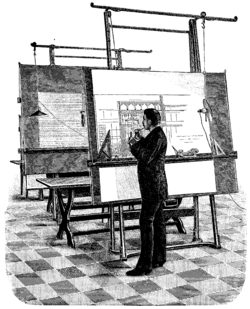
An architect, 1893.
|
|
| Occupation | |
|---|---|
| Names | Architect |
|
Occupation type
|
Profession |
|
Activity sectors
|
Architecture Civil engineering Structural engineering Construction Project management Urban planning Interior design Visual arts |
| Description | |
| Competencies | Engineering, technical knowledge, building design, planning and management skills |
|
Education required
|
See professional requirements |
An architect is a person who plans, designs, and oversees the construction of buildings.[1] To practice architecture means to provide services in connection with the design of buildings and the space within the site surrounding the buildings that have human occupancy or use as their principal purpose.[2] Etymologically, the term architect derives from the Latin architectus,[3] which derives from the Greek[4] (arkhi-, chief + tekton, builder), i.e., chief builder.[5]
The professional requirements for architects vary from location to location. An architect's decisions affect public safety, and thus the architect must undergo specialised training consisting of advanced education[6] and a practicum (or internship) for practical experience to earn a license to practice architecture. Practical, technical, and academic requirements for becoming an architect vary by jurisdiction though the formal study of architecture in academic institutions has played a pivotal role in the development of the profession.
Throughout ancient and medieval history, most architectural design and construction was carried out by artisans—such as stone masons and carpenters—who rose to the role of master builders. Until modern times, there was no clear distinction between architect and engineer. In Europe, the titles architect and engineer were primarily geographical variations that referred to the same person, often used interchangeably.[7][8] "Architect" derives from Greek á¼€ρχιτÎκτων (arkhitéktÅn, "master builder," "chief tektÅn).[5]

It is suggested that various developments in technology and mathematics allowed the development of the professional 'gentleman' architect, separate from the hands-on craftsman. Paper was not used in Europe for drawing until the 15th century but became increasingly available after 1500. Pencils were used for drawing by 1600. The availability of both paper and pencils allowed pre-construction drawings to be made by professionals.[10] Concurrently, the introduction of linear perspective and innovations such as the use of different projections to describe a three-dimensional building in two dimensions, together with an increased understanding of dimensional accuracy, helped building designers communicate their ideas.[10] However, development was gradual and slow-going. Until the 18th century, buildings continued to be designed and set out by craftsmen, with the exception of high-status projects.[10][11]
In most developed countries only those qualified with an appropriate license, certification, or registration with a relevant body (often a government) may legally practice architecture. Such licensure usually requires a university degree, successful completion of exams, and a training period.[12] Representation of oneself as an architect through the use of terms and titles were restricted to licensed individuals by law, although in general, derivatives such as architectural designer were not legally protected.
To practice architecture implies the ability to practice independently of supervision. The term building design professional (or design professional), by contrast, is a much broader term that includes professionals who practice independently under an alternate profession, such as engineering professionals, or those who assist in the practice of architecture under the supervision of a licensed architect, such as intern architects. In many places, independent, non-licensed individuals may perform design services outside of professional restrictions, such as the design of houses or other smaller structures.
In the architectural profession, technical and environmental knowledge, design, and construction management require an understanding of business as well as design. However, design is the driving force throughout the project and beyond. An architect accepts a commission from a client. The commission might involve preparing feasibility reports, building audits, and designing a building or several buildings, structures, and the spaces among them. The architect participates in developing the requirements the client wants in the building. Throughout the project (planning to occupancy), the architect coordinates a design team. Structural, mechanical, and electrical engineers are hired by the client or architect, who must ensure that the work is coordinated to construct the design.
The architect, once hired by a client, is responsible for creating a design concept that meets the requirements of that client and provides a facility suitable to the required use. The architect must meet with and ask questions to the client, to ascertain all the requirements (and nuances) of the planned project.[13]
Often, the full brief is not clear in the beginning. It involves a degree of risk in the design undertaking. The architect may make early proposals to the client which may rework the terms of the brief. The "program" (or brief) is essential to producing a project that meets all the needs of the owner. This becomes a guide for the architect in creating the design concept.
Design proposal(s) are generally expected to be both imaginative and pragmatic. Much depends upon the time, place, finance, culture, and available crafts and technology in which the design takes place. The extent and nature of these expectations will vary. Foresight is a prerequisite when designing buildings as it is a very complex and demanding undertaking.
Any design concept during the early stage of its generation must take into account a great number of issues and variables, including the qualities of the space(s), the end-use and life-cycle of these proposed spaces, connections, relations, and aspects between spaces, including how they are put together, and the impact of proposals on the immediate and wider locality. The selection of appropriate materials and technology must be considered, tested, and reviewed at an early stage in the design to ensure there are no setbacks (such as higher-than-expected costs) which could occur later in the project.
The site and its surrounding environment, as well as the culture and history of the place, will also influence the design. The design must also balance increasing concerns with environmental sustainability. The architect may introduce (intentionally or not), aspects of mathematics and architecture, new or current architectural theory, or references to architectural history.
A key part of the design is that the architect often must consult with engineers, surveyors, and other specialists throughout the design, ensuring that aspects such as structural supports and air conditioning elements are coordinated. The control and planning of construction costs are also part of these consultations. Coordination of the different aspects involves a high degree of specialized communication, including advanced computer technology such as building information modeling (BIM), computer-aided design (CAD), and cloud-based technologies. Finally, at all times, the architect must report back to the client, who may have reservations or recommendations which might introduce further variables into the design.
Architects also deal with local and federal jurisdictions regarding regulations and building codes. The architect might need to comply with local planning and zoning laws such as required setbacks, height limitations, parking requirements, transparency requirements (windows), and land use. Some jurisdictions require adherence to design and historic preservation guidelines. Health and safety risks form a vital part of the current design, and in some jurisdictions, design reports and records are required to include ongoing considerations of materials and contaminants, waste management and recycling, traffic control, and fire safety.
Previously, architects employed drawings[10] to illustrate and generate design proposals. While conceptual sketches are still widely used by architects,[14] computer technology has now become the industry standard.[15] Furthermore, design may include the use of photos, collages, prints, linocuts, 3D scanning technology, and other media in design production. Increasingly, computer software is shaping how architects work. BIM technology allows for the creation of a virtual building that serves as an information database for the sharing of design and building information throughout the life-cycle of the building's design, construction, and maintenance.[16] Virtual reality (VR) presentations are becoming more common for visualizing structural designs and interior spaces from the point-of-view perspective.
Since modern buildings are known to release carbon into the atmosphere, increasing controls are being placed on buildings and associated technology to reduce emissions, increase energy efficiency, and make use of renewable energy sources. Renewable energy sources may be designed into the proposed building by local or national renewable energy providers. As a result, the architect is required to remain abreast of current regulations that are continually being updated. Some new developments exhibit extremely low energy use or passive solar building design.[17] However, the architect is also increasingly being required to provide initiatives in a wider environmental sense. Examples of this include making provisions for low-energy transport, natural daylighting instead of artificial lighting, natural ventilation instead of air conditioning, pollution, and waste management, use of recycled materials, and employment of materials which can be easily recycled.
As the design becomes more advanced and detailed, specifications and detail designs are made of all the elements and components of the building. Techniques in the production of a building are continually advancing which places a demand on the architect to ensure that he or she remains up to date with these advances.
Depending on the client's needs and the jurisdiction's requirements, the spectrum of the architect's services during each construction stage may be extensive (detailed document preparation and construction review) or less involved (such as allowing a contractor to exercise considerable design-build functions).
Architects typically put projects to tender on behalf of their clients, advise them on the award of the project to a general contractor, facilitate and administer a contract of agreement, which is often between the client and the contractor. This contract is legally binding and covers a wide range of aspects, including the insurance and commitments of all stakeholders, the status of the design documents, provisions for the architect's access, and procedures for the control of the works as they proceed. Depending on the type of contract used, provisions for further sub-contract tenders may be required. The architect may require that some elements be covered by a warranty which specifies the expected life and other aspects of the material, product, or work.
In most jurisdictions prior notification to the relevant authority must be given before commencement of the project, giving the local authority notice to carry out independent inspections. The architect will then review and inspect the progress of the work in coordination with the local authority.
The architect will typically review contractor shop drawings and other submittals, prepare and issue site instructions, and provide Certificates for Payment to the contractor (see also Design-bid-build) which is based on the work done as well as any materials and other goods purchased or hired in the future. In the United Kingdom and other countries, a quantity surveyor is often part of the team to provide cost consulting. With large, complex projects, an independent construction manager is sometimes hired to assist in the design and management of the construction.
In many jurisdictions mandatory certification or assurance of the completed work or part of the work is required. This demand for certification entails a high degree of risk; therefore, regular inspections of the work as it progresses on site is required to ensure that the design is in compliance itself as well as following all relevant statutes and permissions.
Recent decades have seen the rise of specialisations within the profession. Many architects and architectural firms focus on certain project types (e.g. healthcare, retail, public housing, and event management), technological expertise, or project delivery methods. Some architects specialise in building code, building envelope, sustainable design, technical writing, historic preservation(US) or conservation (UK), and accessibility.
Many architects elect to move into real-estate (property) development, corporate facilities planning, project management, construction management, chief sustainability officers interior design, city planning, user experience design, and design research.
Although there are variations in each location, most of the world's architects are required to register with the appropriate jurisdiction. Architects are typically required to meet three common requirements: education, experience, and examination.
Basic educational requirement generally consist of a university in architecture. The experience requirement for degree candidates is usually satisfied by a practicum or internship (usually two to three years). Finally, a Registration Examination or a series of exams is required prior to licensure.
Professionals who engaged in the design and supervision of construction projects before the late 19th century were not necessarily trained in a separate architecture program in an academic setting. Instead, they often trained under established architects. Prior to modern times, there was no distinction between architects and engineers and the title used varied depending on geographical location. They often carried the title of master builder[18][19] or surveyor after serving a number of years as an apprentice (such as Sir Christopher Wren). The formal study of architecture in academic institutions played a pivotal role in the development of the profession as a whole, serving as a focal point for advances in architectural technology and theory. The use of "Architect" or abbreviations such as "Ar." as a title attached to a person's name was regulated by law in some countries.
Architects' fee structure was typically based on a percentage of construction value, as a rate per unit area of the proposed construction, hourly rates, or a fixed lump sum fee. Combination of these structures were also common. Fixed fees were usually based on a project's allocated construction cost and could range between 4 and 12% of new construction cost for commercial and institutional projects, depending on the project's size and complexity. Residential projects ranged from 12 to 20%. Renovation projects typically commanded higher percentages such as 15–20%.[20]
Overall billings for architectural firms range widely, depending on their location and economic climate. Billings have traditionally been dependent on local economic conditions, but with rapid globalization, this is becoming less of a factor for large international firms. Salaries could also vary depending on experience, position within the firm (i.e. staff architect, partner, or shareholder, etc.), and the size and location of the firm.
A number of national professional organizations exist to promote career and business development in architecture.

A wide variety of prizes is awarded by national professional associations and other bodies, recognizing accomplished architects, their buildings, structures, and professional careers.
The most lucrative award an architect can receive is the Pritzker Prize, sometimes termed the "Nobel Prize for architecture". The inaugural Pritzker Prize winner was Philip Johnson who was cited as having "50 years of imagination and vitality embodied in a myriad of museums, theatres libraries, houses gardens and corporate structures". The Pritzker Prize has been awarded for forty-two straight editions without interruption, and there are now 22 countries with at least one winning architect. Other prestigious architectural awards are the Royal Gold Medal, the AIA Gold Medal (US), AIA Gold Medal (Australia), and the Praemium Imperiale.[23]
Architects in the UK who have made contributions to the profession through design excellence or architectural education or have in some other way advanced the profession might, until 1971, be elected Fellows of the Royal Institute of British Architects and can write FRIBA after their name if they feel so inclined. Those elected to chartered membership of the RIBA after 1971 may use the initials RIBA but cannot use the old ARIBA and FRIBA. An honorary fellow may use the initials Hon. FRIBA, and an international fellow may use the initials Int. FRIBA. Architects in the US who have made contributions to the profession through design excellence or architectural education or have in some other way advanced the profession are elected Fellows of the American Institute of Architects and can write FAIA after their name. Architects in Canada who have made outstanding contributions to the profession through contributions to research, scholarship, public service, or professional standing to the good of architecture in Canada or elsewhere may be recognized as Fellows of the Royal Architectural Institute of Canada and can write FRAIC after their name. In Hong Kong, those elected to chartered membership may use the initial HKIA, and those who have made a special contribution after nomination and election by the Hong Kong Institute of Architects (HKIA), may be elected as fellow members of HKIA and may use FHKIA after their name.


 architect (P84) (see uses)
| Types |
|
|---|---|
| History |
|
| Professions |
|
| Trades workers (List) |
|
| Organizations |
|
| By country |
|
| Regulation |
|
| Architecture |
|
| Engineering |
|
| Methods |
|
| Other topics |
|
 Outline Outline  Category Category |
|
|
Authority control databases
|
|
|---|---|
| International |
|
| National |
|
| Other |
|


Very good architectural firm in NYC. Highly recommended !

Taf was the perfect architect to complete our filing with the NYC DOB for the washer-drier we wished to install in our coop apartment.

Thank you Mr. Taf & team. We look forward to working with you again on another successful project. I hope by the this Covid pandemic will be history!

Mr Mwandiambira, gave me a thorough explanation on what to expect in navigating the DOB's complex application submission process to get approval for alterations to my home. I was pleasantly surprised at how quickly an acceptable plan was composed. I would highly recommend Baobab Architects to anyone seeking a top quality architectural firm.

Baobab Architects is an architectural firm based in Brooklyn, New York City. NYC alteration type 1 architects, NYC alteration type 2 architects, affordable housing architects, or small development, NYC, and Baobab.
We appreciate your budget-conscious mindset! Baobab Architects P.C. prioritizes transparency and meticulous planning to ensure your project stays within budget. Our team conducts thorough cost analyses, providing detailed estimates and regular updates. Explore our commitment to budget-friendly excellence at www.baobabarchitects.com/. Ready to embark on a financially savvy architectural journey? Contact us today!
We truly appreciate your interest in Baobab Architects P.C.! What sets us apart is our unwavering commitment to delivering innovative and bespoke architectural solutions tailored to the unique charm of New York. Our team of seasoned architects thrives on creating spaces that resonate with your vision and the city's spirit. Check out our portfolio at www.baobabarchitects.com/ to witness the magic. Ready to transform your dreams into reality? Contact us today!
Your focus on satisfaction resonates deeply! Baobab Architects P.C. is dedicated to exceeding client expectations. From initial concept to project completion, our team prioritizes clear communication, attention to detail, and your unique vision. Explore our client success stories at www.baobabarchitects.com/. Ready to experience architectural excellence? Contact us, and let's create something extraordinary together!


